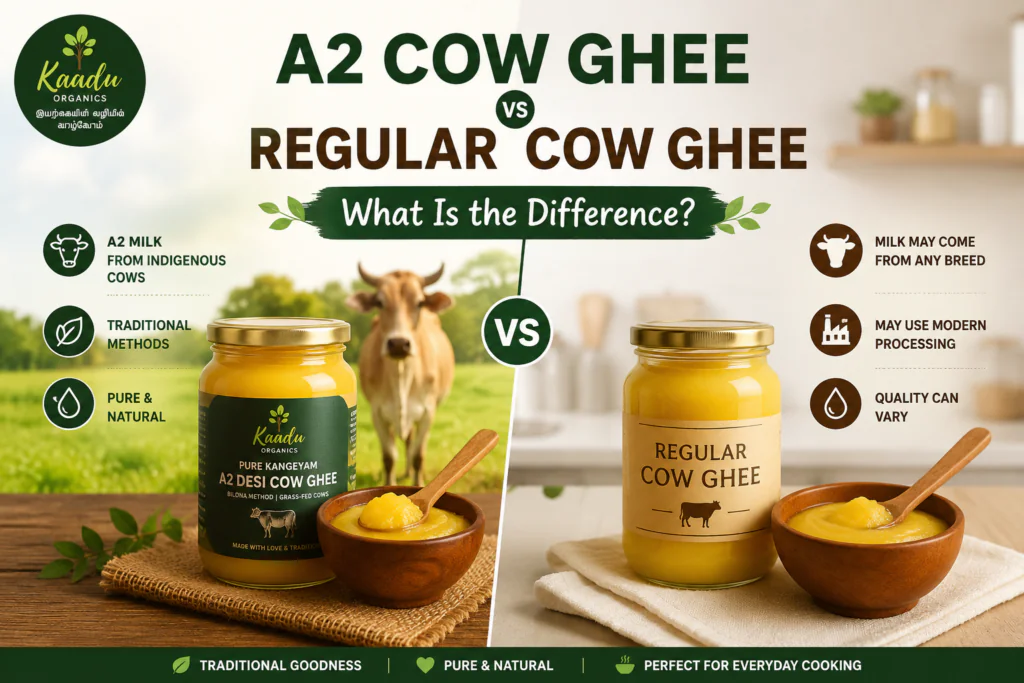
A2 Cow Ghee vs Regular Cow Ghee: What Is the Difference?
Ghee has always been a part of the culinary tradition of India. Whether used as a flavoring ingredient in hot rice and dal, or in sweets, pongal, biryani and traditional recipes, you will find ghee in various Indian households.
However, when you go shopping for ghee, you might come across various types of products. One such product which has become very popular is the A2 cow ghee.
You will also encounter regular cow ghee, desi cow ghee and A2 desi cow ghee.
What is the difference between A2 cow ghee and regular cow ghee? Does the former differ from the latter at all? What are the things you need to take into consideration before buying ghee?
In this article, you will be able to know the difference in detail.
What Is A2 Cow Ghee?
The ghee produced from milk of cows that produce A2 type of beta-casein protein is known as A2 cow ghee.
There are various proteins found in milk. Among them, beta-casein is one. A2 and A1 are two different types of this protein.
In case the milk of cows known to produce A2 milk is used for ghee production, then the end product will be termed as A2 cow ghee.
But there is something that needs special attention here.
Mostly, the ghee production involves fat from the milk. While going through the process of ghee making, most of the water content along with milk solids and proteins gets removed from the milk. This means that the A2 classification actually indicates the milk used prior to ghee production.
Therefore, it would be more appropriate to consider the whole story of the product.
What Is Regular Cow Ghee?
Regular cow ghee means ghee prepared from cow’s milk.
Sometimes, the phrase ‘regular cow ghee’ does not give much information about the specific breed of the cow used or even the type of beta-casein present in the milk.
There are various breeds of cow milk available depending on the brand.
Similarly, the method used for making the ghee differs according to each brand.
Some brands follow traditional methods, while other brands use modern dairy processing methods.
In this regard, the distinction between A2 cow ghee and regularity cow ghee is the source of milk and its identification.
A2 Cow Ghee vs Regular Cow Ghee: The Main Difference
The easiest way to understand the difference is to look at the milk used to make the ghee.
| Feature | A2 Cow Ghee | Regular Cow Ghee |
|---|---|---|
| Milk source | Milk from cows identified as producing A2-type beta-casein | Cow’s milk, with the exact protein type not always specified |
| Cow breed | May be an indigenous or other identified breed | May come from different cow breeds |
| Protein classification | Associated with A2 beta-casein milk | Not necessarily specified |
| Taste and aroma | Depends on the milk and preparation method | Depends on the milk and preparation method |
| Colour | Can vary naturally | Can vary naturally |
| Preparation | Can be traditional or modern | Can be traditional or modern |
| Quality | Depends on sourcing and processing | Depends on sourcing and processing |
It is important to remember that A2 does not automatically mean better quality.
The quality of ghee also depends on the milk source, cleanliness, processing, storage, packaging and other factors.
Is A2 Cow Ghee Made From Desi Cows?
Not necessarily.
This is a common misconception.
“A2” stands for a kind of beta-casein protein found in milk. “Desi cow” means native Indian cows.
These are not one and the same.
There are several breeds of Indian native cows that produce A2 milk. These are, for instance, Gir, Sahiwal, and Kankrej.
Thus, a particular product may be referred to as A2 cow ghee and at the same time come from an indigenous cow breed.
When choosing A2 ghee, make sure that its label says about the breed of the cow and milk origin.
What Is Kankrej Cow Ghee?
Kankrej cattle are an indigenous Indian cattle breed associated primarily with Gujarat and Rajasthan. The National Dairy Development Board (NDDB) lists Kankrej as a milk-and-draught breed, with its breeding tract spanning parts of Gujarat and Rajasthan.
The breed is particularly associated with the region around the Rann of Kutch in Gujarat and adjoining parts of Rajasthan. Its long history in the region reflects its importance in traditional dairy and agricultural systems.
Therefore, Kankrej is a relevant breed to understand when discussing indigenous Indian cattle and traditional cow ghee.
The Pure Kankrej A2 Desi Cow Ghee by Kaadu Organics is a product which has been marketed based on the indigenous Kankrej cows and traditional cow ghee.
When choosing a ghee product that has a distinctive regional and breed identity, it may be helpful to know the origin of milk.
More information about the product can be found here:
Discover Kaadu Organics Pure Kankrej A2 Cow Ghee
Does A2 Cow Ghee Taste Different?
The taste of ghee can depend on several factors.
These include:
- The type of milk used
- The cow breed
- The animal’s feed
- The freshness of the milk
- The preparation method
- The heating process
- How the ghee is stored
Because of this, it is difficult to say that every A2 cow ghee will taste the same.
A traditionally prepared desi cow ghee may have a rich aroma and a distinct flavour. But the taste can still vary between brands.
If you are buying ghee online, look beyond the word “A2” and check the product description for information about its milk source and preparation.
Is A2 Cow Ghee Healthier Than Regular Cow Ghee?
This question seems to be one of the most asked ones.
One must be very cautious about making health claims.
Despite being a type of ghee, which is a highly concentrated milk fat, it is advisable to use it as a part of a healthy diet.
However, the term “A2” by itself is not a guarantee of any particular health benefits of the product.
While there are debates about the pros and cons of A1 and A2 milk proteins, it would be premature to claim that any A2 ghee prevents any diseases or treats health issues.
For the ordinary consumer, it is much more important to evaluate the overall quality of the product.
For instance, one should consider:
- Its source
- The breed of cows used
- The process of ghee production
- Its ingredients
- The packaging
The availability of information on the product provided by the manufacturer.
How Is Traditional Cow Ghee Made?
There are many traditional ways of preparing ghee that have been practiced by Indians for many years.
The first step in this process is to prepare curd, which depends on the traditional method used.
Fat is then separated from the mixture and prepared into ghee through heating.
While heating, all components except the fat component are taken out of the mixture.
As a result, we get our gold-colored fat component known as ghee.
Since there are various methods of preparing ghee, there is the possibility that the aroma and texture will differ from one producer to another even though both use the same ingredients, such as cow’s milk.
It is important to look at the preparation method rather than terms like “traditional” or “pure” when purchasing traditional ghee.
A2 Cow Ghee vs Regular Cow Ghee: Which One Should You Buy?
There can be no one answer for all.
If you just need cow ghee for your daily cooking purpose, then regular cow ghee will suffice.
If you need ghee made from milk containing A2 type beta-casein and want to learn more about the breed of the cow and the source of the milk, you can go for A2 cow ghee.
It depends on what is important to you.
For instance, you may need:
Identified breed of the cow
If the brand gives information about the breed of the cow whose milk they use, you get an idea about the product.
Source identification
Go for those brands which mention where they source their milk.
Simplicity of the ingredients
Read the label and make sure you know what you are purchasing.
A trusted preparation process
If you value traditional preparation, check whether the brand mentions their preparation process or not.
Good packaging and storage
The ghee needs to be packaged and stored properly.
How to Choose the Best A2 Cow Ghee
If you plan to purchase A2 cow ghee online, never purchase a product solely based on how the packaging looks.
Some of the factors you can verify include:
1. Verify the Breed of Cows
Is there any information regarding the breed used by the company?
This means that products with clear breed information are more detailed than those labeled “A2.”
2. Ingredients
Go through the ingredient list of the product.
A genuine ghee product has an ingredient list that is easy to understand.
3. Source
What is the source of milk used?
This will help you determine whether the company can prove their sourcing process.
4. Method of Preparation
Do they provide a detailed description of the preparation process?
You need this information to understand the product well.
5. Packaging
It should help prevent contamination of the ghee from humidity, light, heat and contamination.
Always adhere to the recommendations provided by the manufacturer.
6. Find Real Customer Reviews
Customer reviews can help you understand the customer experience.
However, avoid relying on the star ratings only. Read the actual reviews and see what customers say regarding taste, aroma, packaging and delivery.
7. Information, not the Price
Sometimes cheaper products can be of low quality.
When comparing two ghee products, consider the milk source, breed of cows, ingredients, preparation method, quantity and packaging.
How Can You Use A2 Cow Ghee?
A2 cow ghee can be used in many everyday Indian dishes.
You can add it to:
- Rice and dal
- Pongal
- Chapati
- Dosa
- Idli podi
- Upma
- Curries
- Sweets
- Traditional rice dishes
You can also use it for tempering spices or cooking recipes where you want the rich aroma of ghee.
Kaadu Organics’ Pure Kankrej A2 Desi Cow Ghee can be used as an everyday cooking ingredient while also fitting traditional Indian recipes.
A2 Cow Ghee: What Should You Remember?
The primary distinction between A2 cow ghee and regular cow ghee is the details provided regarding the milk from which the ghee is manufactured.
A2 cow ghee is related to milk produced by cows known to produce A2 beta-casein protein. Regular cow ghee is merely ghee made from cow’s milk, without the need for it to be specified as to whether the milk has the A2 beta-casein.
However, apart from this, there are other factors to consider while selecting a good quality ghee.
Breed of the cow, source of milk, manufacturing process, ingredients, packaging, and product information are all important.
If you are someone who uses indigenous cow milk products and would like to be informed about the ghee that you buy, choose the brand that offers you detailed information about their products.
There are certain brands which offer Kankrej A2 desi cow ghee such as Kaadu Organics.
Conclusion
The choice between A2 cow ghee and regular cow ghee comes down to more than just the name on the jar.
If you are buying ghee for your family, take a few minutes to understand where the milk comes from, which cow breed is involved and how the ghee is prepared.
For people looking for an indigenous cow ghee option associated with Gujarat and Rajasthan, Kankrej A2 desi cow ghee offers an interesting traditional choice.
If you want to explore Kaadu Organics products, you can view the[ ][Pure Kankrej A2 Desi Cow Ghee] and check the available pack sizes and product details.
Frequently Asked Questions
Is A2 cow ghee the same as regular cow ghee?
No. Both are cow ghee, but A2 cow ghee refers to ghee made from milk associated with A2-type beta-casein. Regular cow ghee does not necessarily specify the beta-casein type of the milk.
Is all desi cow ghee A2?
Not automatically. “Desi cow” refers to indigenous Indian cattle breeds, while “A2” refers to a type of beta-casein associated with the milk. The product’s sourcing information should confirm what is being offered.
Is A2 cow ghee suitable for cooking?
Yes. Ghee is commonly used in Indian cooking, including rice dishes, dal, sweets, curries, tempering and traditional recipes.
What is Kankrej A2 cow ghee?
Kankrej A2 cow ghee is ghee made using milk from Kankrej cows identified as producing A2-type milk. Kankrej is an indigenous cattle breed associated primarily with Gujarat and Rajasthan.
How should I choose A2 cow ghee online?
Check the cow breed, milk source, ingredients, preparation method, packaging, customer reviews and other product information before buying.
Does A2 mean the ghee has more nutrients?
Not necessarily. A2 describes a type of beta-casein associated with the milk used before the ghee-making process. It should not automatically be taken as a claim that the final ghee contains more nutrients.
Is A2 cow ghee better than regular cow ghee?
It depends on your preferences. If you want ghee made from milk associated with A2-type beta-casein and prefer a clearly identified cow breed, A2 cow ghee may be the option you are looking for. Overall product quality still depends on sourcing and preparation.
Sources for Kankrej breed information
- National Dairy Development Board (NDDB): Kankrej is listed as a cattle breed with a breeding tract in Gujarat and Rajasthan and uses including milk and draught.
- ICAR: Kankrej is included among important indigenous cattle breeds under conservation and genetic-improvement programmes.