How Traditional Cow Ghee Is Made: From Milk to Ghee
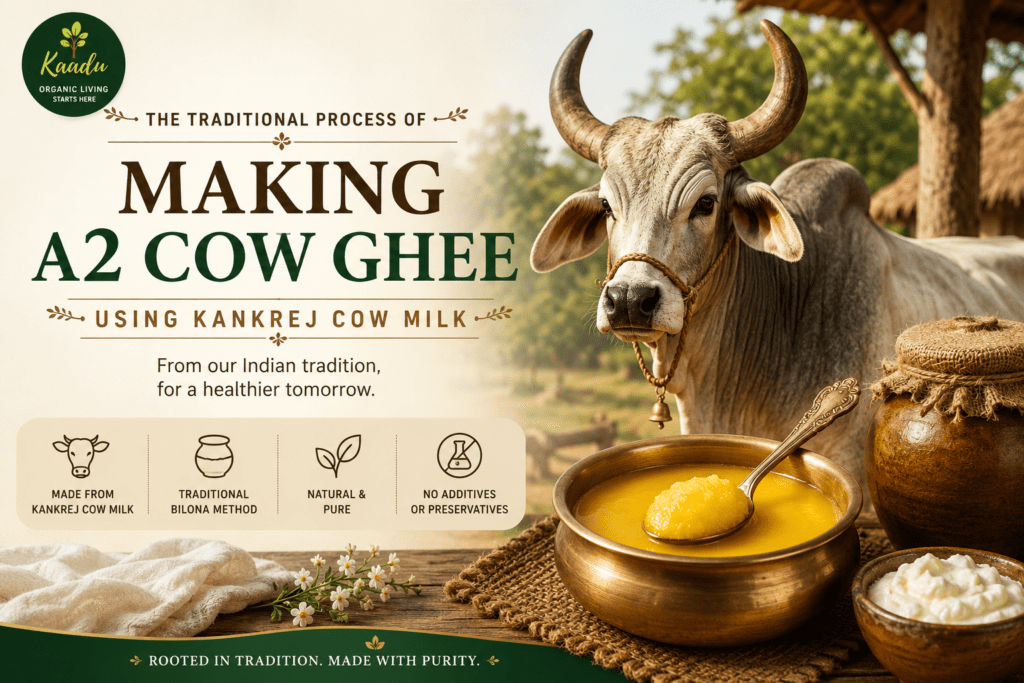
The use of ghee in Indian households has been a tradition that has been around for centuries.
Our parents have always had ghee along with hot rice, daal, chapatti, pongal, and many types of sweets. Till today, ghee still remains an essential ingredient in every Indian household.
Have you ever thought of how milk gets converted to this delicious ghee?
Preparing ghee in the traditional way involves more than just boiling of milk and preparation of butter from the milk. There are many different ways in which ghee can be prepared by using different components such as milk, curd, butter, and boiling.
In this article, our aim is to provide you with some information regarding the traditional process of making ghee. We will also learn about the making of A2 ghee using cows. The significance of cows and differences between traditional ghee and other ghee’s will be emphasized.
What Is Traditional Cow Ghee?
“Ghee” refers to clarified butter obtained from cow milk.
As the term “clarified” suggests, the process involves the extraction of milk water and other elements from the butter by heating. The residue left after the process is nothing but milk fat known as ghee.
There can be different methods of ghee production, ranging from modern methods followed by large scale dairy companies to old fashioned methods that may have been in practice in Indian households for decades.
One such traditional method involves the following steps:
Cow Milk > Curd > Butter > Ghee
It is a slow process compared to the extraction of cream. However, it is associated with the traditional method of ghee making in India.
Step 1: Fresh Cow Milk Is Obtained
Obtaining fresh and high-quality cow milk is the initial step of the traditional ghee making process.
The quality of ghee depends largely on the type of milk used initially. That is the reason why the choice of the milk is of significant importance.
The breed of the cow that produces the milk can be important information when talking about indigenous ghee.
For instance, Kaadu Organics’ Pure Kankrej A2 Desi Cow Ghee is produced in the area of Kankrej cow milk – the indigenous breed of cattle from the area of Rajasthan.
Milk serves as the basis for producing good ghee.
Step 2: Preparation of the Milk for Curd Making
As part of the traditional process, milk is heated up and cooled down to a suitable temperature.
A little bit of curd culture can be added to the milk, which is then allowed to curdle.
Over time, milk turns into curd.
It is an essential stage since the traditional production of ghee implies curd as the base for the process of butter-making.
Each manufacturer has its own recipe.
Step 3: Milk Changes to Curd
In a few hours, the milk becomes thick curd.
Time may vary based on the temperature, quality of the milk used and the method used.
In the olden times, it was an overnight process in the kitchen.
Next morning, the curd was ready for the next process.
That was another reason why traditional ghee preparation took a long time. It was not a process that involved just a single stage but many.
Step 4: Butter Extraction from Curd
Let’s move to the most exciting part now.
The process of churning helps in extracting butter from the curd.
In the old days, it would be achieved with the help of wooden chummers known as Mathani.
The churning goes on till butter particles start sticking to each other.
Particles stick and create butter while the liquid remains as buttermilk.
This process of butter extraction is entirely different from that of extracting butter from the cream of milk.
The process of extracting butter from curd is traditionally referred to as the Indian butter extraction process.
Step 5: Butter Collection
Having separated butter from the curd, you will need to collect butter from buttermilk.
Now, the butter can be rinsed with water to remove buttermilk.
This will enable you to prepare your butter for the next step.
During this step, you will have butter and not ghee.
The butter will contain water and some milk solids.
Thus, the process is far from being completed at this stage.
Step 6: Butter Heating Process
Now, fresh butter should be heated in an appropriate container.
With time, water will evaporate from the butter.
Further, the butter melts and becomes liquid.
While heating continues, moisture decreases and milk solids begin to separate.
This step is the stage when ghee’s distinct aroma is created.
This step requires one to be careful while heating butter.
Overheating of butter leads to its burning and in case of under-heating – to high moisture level.
Step 7: Aroma Creation of Ghee
Furthermore, heating of butter results in the liquid’s change.
Liquid becomes golden and releases a very specific aroma in the kitchen.
Besides, milk solids fall at the bottom of the container.
This step is extremely important in making ghee as the timing of this final process determines the color, aroma and taste of ghee.
This is one of the many reasons why ghee made traditionally has a distinct aroma and taste.
Step 8: Separation of Milk Solids
With the continuation of the heating process, the milk solids start separating from the fat.
Ghee becomes clear in its appearance, whereas the milk solids settle down at the bottom.
After that, the ghee needs to be allowed to sit for a certain amount of time.
The appearance of the ghee differs depending upon the type of milk used, procedure adopted, and heating process.
In some cases, the traditional ghee looks very aromatic and golden in color.
The most important point is that the ghee should be made in a proper way without burning it.
Step 9: Straining the Ghee
As soon as the heating process ends, the ghee is strained.
Straining can be done using clean filters.
The strained ghee is ready to be cooled and packed.
As the ghee cools down, it changes its form from liquid to semi-solid.
Depending upon the temperature, the ghee remains soft or hard.
It is absolutely normal for the ghee.
What Makes A2 Cow Ghee Different?
You might have encountered the term “A2 cow ghee” on many products.
“A2” refers to the type of beta-casein protein present in the milk utilized for manufacturing the product.
“A2 cow ghee” is made by using the milk of cows that have been identified as A2 type of beta-casein.
It should be noted that there is a difference between the terms “A2” and “desi cow.”
“A2” refers to the type of beta-casein found in the milk.
“Desi cow” refers to the native breeds of Indian cows.
This is why it is crucial to consider the breeds of the cows and the source of milk when purchasing A2 cow ghee.
What Is Kankrej Cow Ghee?
The Kankrej breed is an indigenous cattle breed associated with Gujarat and parts of Rajasthan.
The breed is named after the Kankrej region of Gujarat and has a long association with farming and cattle-rearing traditions in western India.
Kankrej cattle are well regarded as an indigenous Indian cattle breed, particularly associated with Gujarat and parts of Rajasthan.
In relation to products such as Kankrej A2 cow ghee, the cow breed plays an integral role in the branding.
One of the products offered by Kaadu Organics includes Pure Kankrej A2 Desi Cow Ghee based on the indigenous cow breed.
Here is a chance to learn more about the product:
Pure Kankrej A2 Cow Ghee – Kaadu Organics
Traditional Ghee vs Modern Ghee Making
Not every ghee product is made in the same way.
Large dairy operations may use modern equipment to process milk, separate cream, make butter and produce ghee at scale.
Traditional methods can involve more stages and may follow the milk-to-curd-to-butter-to-ghee process.
The main difference is often the production approach.
Here is a simple comparison:
| Traditional Ghee Making | Modern Ghee Production |
|---|---|
| May begin with milk and curd | May use cream or butter as the starting material |
| Can involve traditional churning | Often uses mechanical equipment |
| Usually takes more time | Designed for large-scale production |
| Can be made in smaller batches | Usually produced in larger quantities |
| Strong focus on traditional methods | Strong focus on efficiency and consistency |
Neither method should automatically be called “better” just because it is traditional or modern.
The quality of the final product depends on the ingredients, processing, hygiene, storage and quality controls used by the producer.
Why Does Traditional Ghee Have a Rich Aroma?
One of the reasons why traditional ghee is so popular is because of its aroma.
In the process of heating, water is extracted and milk solids separated. As a result, the cooked-butter and nutty scent characteristic of ghee is produced.
The resulting aroma will depend on factors such as:
- Milk type
- Cow breed
- Freshness of the milk
- Preparation method
- Heating temperature
- Duration of heating
- Storage conditions
That is why ghee made by two different manufacturers may have different scents and tastes.
Is Traditional A2 Cow Ghee Healthier?
This is one of the most common questions asked when purchasing A2 cow ghee.
The truth is that you should not make any health claims just because the product is labeled as either A2 or traditional.
Ghee is high in milk fat content, and should be consumed in reasonable amounts as part of a healthy balanced diet.
A2 is a characteristic of the beta-casein present in milk before the production of ghee starts. It should not be taken as a sign that the product is going to be beneficial for your health in some way.
What you need to do is to consider the whole picture.
Consider:
- Milk origin
- Cow breed
- Product ingredients
- Production method
- Packaging
- Storage information
- Information from the product manufacturer
This way you will understand what you are really purchasing.
How to Identify a Good Traditional Cow Ghee
When purchasing traditional cow ghee, do not consider the only labeling statement which says “traditional”.
Go into the details.
1. Examine the Source of Milk
Is the brand providing you information about the source of milk?
Having sourcing information will make it easier to decide.
2. Consider the Breed of the Cow
In case your preferred product is produced from an indigenous breed, check whether the brand clearly mentions the breed.
For instance, Kaadu Organics labels its ghee Kankrej A2 Desi Cow Ghee.
3. Read the List of Ingredients
The product page should clearly mention the components of the ghee.
Do not rely only on marketing terms.
4. Consider the Manufacturing Method
Seek for any information about the process of producing the ghee.
The manufacturing method should be clearly stated by a reliable brand.
5. Pay Attention to the Packaging
A ghee should have proper packaging to prevent exposure to moisture and contaminants.
Obey the storage instructions provided by the product.
6. Read Customer Reviews
Customer reviews may provide you information about such features as the taste, aroma, texture, packaging and delivery of the product.
Do not concentrate only on the number of stars.
How to Store Traditional Cow Ghee
When you purchase ghee, it is necessary to store it properly.
- It is crucial to keep the lid of the bottle shut tightly after every usage.
- A clean and dry spoon should be used to remove ghee from its container.
- The product should be stored as per the manufacturer’s instructions on how to store it.
The texture of ghee changes with the change in temperature. Ghee becomes liquid in a hot kitchen and firm in a cold environment.
This is a natural occurrence.
How Can You Use Traditional Cow Ghee?
Traditional cow ghee can be used in many Indian dishes.
You can add it to:
- Hot rice and dal
- Pongal
- Chapati
- Dosa
- Idli podi
- Upma
- Curries
- Sweets
- Traditional rice dishes
It can also be used for tempering spices or cooking dishes where you want the rich flavour and aroma of ghee.
A small amount can add a distinct taste to simple everyday food.
Why Does Traditional Ghee Making Still Matter?
There are now machines available which can prepare the food quicker.
However, conventional methods of preparing food will still find their way into the Indian kitchen because they are a part of the Indian food tradition.
An example would be the preparation of ghee from milk.
This is a time-consuming process.
Milk is prepared. Curd is made. Curd is then churned to obtain butter. The butter is heated. Milk solids are separated out. Lastly, the ghee is strained and packed.
Each step has an objective.
For companies like Kaadu Organics, keeping the emphasis on indigenous foods and traditional food preparation methods will help link everyday foods with the Indian food tradition.
Final Thoughts
Cow ghee has been traditionally prepared using a step-by-step procedure that converts milk to curd and curd to butter, and finally to ghee.Though this seems like a simple procedure, each step is very essential.
The milk source, cow type, preparation process, and cooking process can have an effect on the final product.In case you are looking for A2 cow ghee, then it is essential to know what A2 is, and more importantly, look beyond the tag.
You need to know about the cow type, milk source, ingredients used, and preparation process while purchasing the product.If you are looking for ghee made from an indigenous Indian cattle breed, you may consider Kaadu Organics Pure Kankrej A2 Desi Cow Ghee.
Explore Kaadu Organics Pure Kankrej A2 Cow Ghee
Not everything about good food is just eating the food itself.
Frequently Asked Questions
How is traditional cow ghee made?
Traditional cow ghee can be made by following a process of milk → curd → butter → ghee. The milk is turned into curd, the curd is churned to separate butter, and the butter is slowly heated until the water evaporates and the milk solids separate.
Is A2 cow ghee made differently?
The basic ghee-making process can be similar. The main difference is the source of the milk. A2 cow ghee is made from milk sourced from cows identified as producing A2-type beta-casein.
What is the traditional method of making ghee?
A traditional method can involve fermenting milk into curd, churning the curd to obtain butter and slowly heating the butter to make ghee.
What is Kankrej A2 cow ghee?
Kankrej A2 cow ghee is ghee made using milk from Kankrej cows identified as producing A2-type milk. Kankrej is an indigenous cattle breed associated with Gujarat and parts of Rajasthan.
Why is traditional ghee yellow or golden?
The colour of ghee can vary depending on factors such as the milk, cow breed, preparation method and heating process. Traditional ghee can have a golden or yellow appearance.
Can I use traditional cow ghee for everyday cooking?
Yes. Cow ghee can be used for cooking, seasoning, tempering, rice dishes, sweets and many traditional Indian recipes.
Does traditional ghee have a longer shelf life?
Ghee has a relatively long shelf life when properly prepared and stored, but the actual shelf life depends on the product and its packaging. Always follow the manufacturer’s best-before date and storage instructions.
Is traditional cow ghee better than regular ghee?
Not necessarily. “Traditional” describes the preparation approach. The quality of ghee depends on factors such as milk source, ingredients, processing, hygiene and storage.
Is A2 cow ghee healthier than regular ghee?
A2 describes a type of beta-casein associated with the milk used to make the ghee. It should not automatically be treated as proof of special health benefits. Ghee is a concentrated source of milk fat and should be consumed as part of a balanced diet.