Kankrej Cow: Origin, Characteristics, Milk, and Why This Indigenous Breed Matters
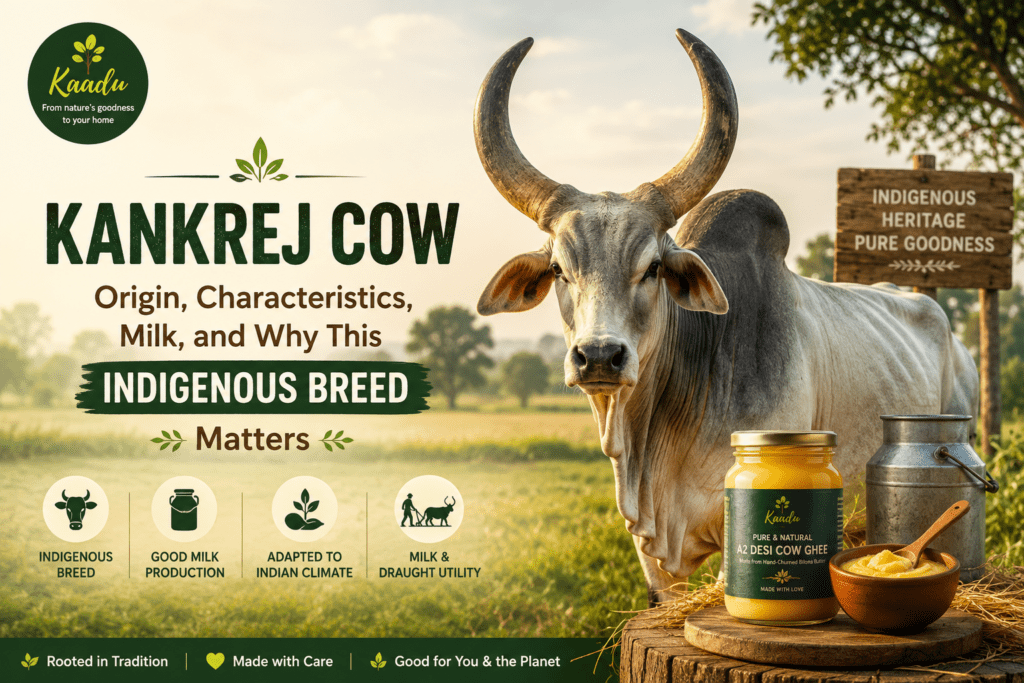
There are many indigenous breeds of cows found in India, which are suitable for climatic conditions, agricultural practices, and requirements of their native area. Out of these breeds, Kankrej cows are considered one of the breeds of cows found in western India.
Because of their strength, adaptation, unique appearance, and ability to be used as draught animals as well as for milk production, Kankrej cows have an important place in the indigenous cattle breeds of India.
In this guide, we will learn what Kankrej cows are, their origins, physical traits, milk production, and relation to other indigenous cow breeds and A2 milk.
What Is a Kankrej Cow?
The Kankrej breed is an indigenous cattle breed mostly found in Gujarat and Rajasthan. The native tract of the Kankrej cattle breed as recognized by the NDDB includes regions close to the southeast of the Rann of Kutch in the districts of Mehsana, Kutch, Ahmedabad, Kheda, Sabarkantha, and Banaskantha in Gujarat as well as Barmer and Jodhpur in Rajasthan.
The Kankrej breed is traditionally considered to be a dual-purpose cattle breed because this breed was used for both dairy and agricultural purposes.
The Kankrej breed has also been the focus of conservation and genetic improvement programmes in India. The Kankrej breed is one of the indigenous breeds which are conserved and genetically improved in ICAR.
Where Did the Kankrej Cow Originate?
Kankrej cattle breed originated in the dry and semi-dry areas of western India, especially the states of Gujarat and Rajasthan.
Its natural habitat has contributed to the development of a breed of cattle suitable for difficult climatic conditions as well as traditional farming practices. Through selective breeding over several generations, traits such as strength, hardiness, adaptability, and good milk yield have been incorporated into the breed.
This explains why indigenous cattle breeds like Kankrej are considered vital in the study of Indian livestock history.
Physical Characteristics of Kankrej Cows
There are many unique physical attributes that characterize this breed and make them somewhat easy to identify.
These physical attributes include:
- Having a strong and well-built body
- Having a wide forehead
- Horns that are large and shaped like lyres
- Having a pronounced hump
- Having strong legs and hooves
- A usually grey or silver grey color of their coat
- Being generally strong in build
The bulls are greatly prized for their strength and ability to pull, while the cows are used for their milk production.
Kankrej Cow Milk Production
Kankrej is classified as a milk and draught animal as per the NDDB. The breed information provided by the NDDB indicates that the average milk output of the breed is around 1,738 kg, and the range is around 800–1,800 kg.
Thus, it is important not to assume that every Kankrej animal gives the same amount and quality of milk.
Proper nutrition, veterinary treatment, breeding program, and farm management affect milk production.
Is Kankrej Cow Milk A2 Milk?
It is a crucial issue since the Kankrej breed is indigenous to India and sometimes linked to A2 milk production.
Nevertheless, only the identification of the breed cannot be taken as a guarantee that the milk of all Kankrej cows is indeed A2 milk.
The type of beta-casein protein depends on the genetics of the animal. If the seller intends to market milk as A2 or A2A2, testing and verification are needed.
It is especially important for the consumers who are purchasing milk or A2 ghee made from cow milk.
Why Are Kankrej Cows Important?
Kankrej cattle are important for several reasons.
1. History of indigenous cattle
One of India’s indigenous cattle breeds includes the Kankrej breed. Keeping such breeds assists in maintaining the country’s livestock genetic diversity.
2. Adaptability
This breed has evolved under the weather conditions of western India and adaptability is one of its distinguishing traits.
3. Multiple usages
As opposed to breeds that are mainly bred for dairy purposes, Kankrej serves multiple purposes. It is classified by the NDDB as a milk and draught breed.
4. Breeding program
Kankrej forms part of the indigenous cattle breeding program conducted by ICAR.
Kankrej Cow vs Gir Cow
Kankrej and Gir are both important indigenous cattle breeds associated with Gujarat, but they are distinct breeds.
| Feature | Kankrej Cow | Gir Cow |
| Main region | Gujarat and Rajasthan | Gujarat |
| Type | Milk and draught | Primarily milk |
| Appearance | Generally grey/silver-grey | Commonly red, speckled or white variations |
| Horns | Distinctive upward/lyre-shaped horns | Curved horns |
| Traditional role | Milk and agricultural work | Primarily dairy, with other traditional uses |
Both breeds are important parts of India’s indigenous cattle heritage, but their characteristics and traditional roles are different.
Kankrej Cow and Traditional Indian Dairy Practices
Domestic cattle have existed in Indian agriculture in the past, contributing milk, as well as agricultural utility and other benefits on the farms.
This makes Kankrej fascinating since its historical background encompasses these roles. Breeding programmes today still aim at preserving indigenous cattle and enhancing their production qualities.
The ICAR cattle breeding programs incorporate Kankrej as one of the breeds being researched for conservation and improvement.
Final Thoughts
Kankrej cows are an important component of the Indian indigenous cattle population. The breed is native to western India and has been appreciated for the unique blend of milk yield, power, and agronomic value.
Consumers looking for indigenous cow milk and A2 cow ghee should consider getting familiar with the Kankrej cows. Nevertheless, in the process of assessing the A2 products, it is vital to draw a line between the breed characteristics and the beta-casein status.
With the rise of the consumer interest in traditional milk and indigenous cattle, knowledge of the source and production of the product becomes critical.
Frequently Asked Questions About Kankrej Cows
Is Kankrej an Indian cow breed?
Yes. Kankrej is an indigenous cattle breed associated primarily with Gujarat and Rajasthan.
Where are Kankrej cows found?
Their native tract includes several districts of Gujarat and parts of Rajasthan, particularly areas around the southeast of the Rann of Kutch.
Are Kankrej cows used for milk?
Yes. Kankrej is classified by NDDB as a milk-and-draught breed, and NDDB reports an average milk yield of about 1,738 kg.
Is every Kankrej cow A2?
Not necessarily. A2 status relates to beta-casein genetics, so a blanket A2 claim should not be made solely from the breed name. Appropriate testing and verification are preferable when making a specific A2A2 claim.
Is Kankrej cow good for making ghee?
Milk from Kankrej cows can be used to make ghee. The characteristics of the finished ghee depend on the milk, processing method, and other production factors.