Sesame Oil, Gingelly Oil, Nallennai and Til Oil: Are They the Same?
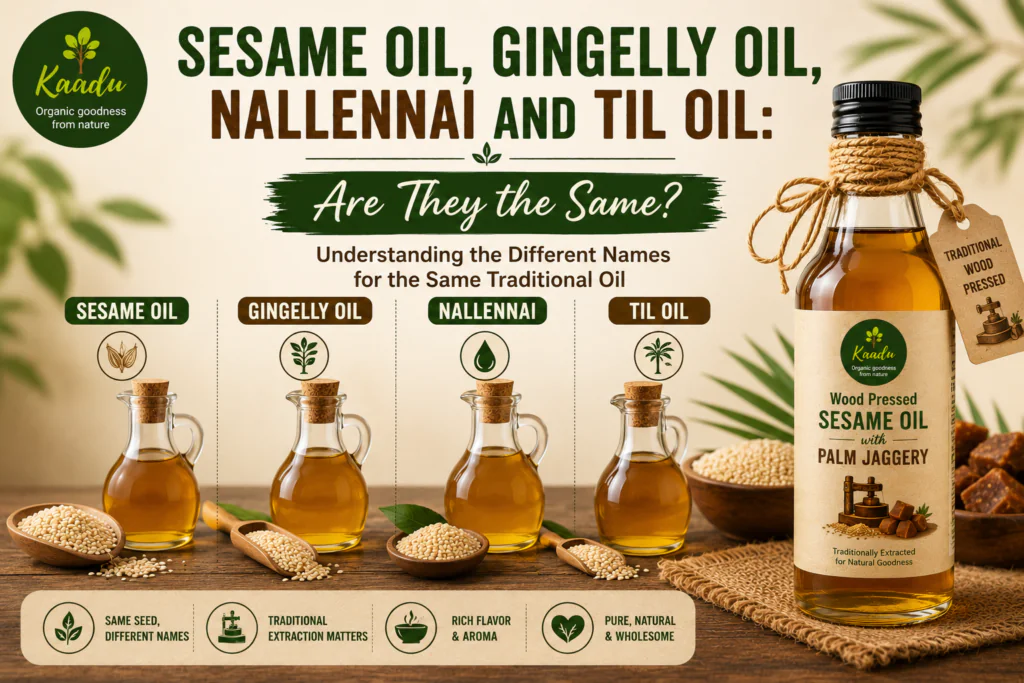
Have you ever looked for sesame oil and came across five different terms?
Sesame oil, Gingelly oil, Nallennai, Til oil, Ellu ennai.
At the outset, you may think that these are five separate products.
Are they?
Well, in most cases, the answer would be yes but there is an important distinction to note.
These terms refer to oils produced from the sesame seeds. But the process of extraction, filtration and processing could differ from product to product.
If you are new to traditional oils, let us keep it simple.
What Is Sesame Oil?
Sesame oil is oil derived from sesame seeds.
Sesame seeds are seeds that grow on the sesame plant. They are also known as ellu in Tamil.
Upon pressing the seeds, a golden oil with a natural nutty scent is obtained.
For years now, sesame oil has been used in Indian cuisine. It is most used in South Indian cuisine in dishes like rice, podi, kuzhambu, pickles, and more.
The oil that you see in the bottle is produced through various extraction techniques.
Some of these include:
- Wood pressed
- Cold pressed
- Mechanically pressed
- Refined
In essence, “sesame oil” only indicates the origin of the oil, not necessarily the method by which it was produced.
What Is Gingelly Oil?
Now, let’s discuss the oil called gingelly oil.
Gingelly oil is yet another English name of sesame oil which is popular in South India.
When a person states the following:
“Put some gingelly oil in the kuzhambu.”
It means they are referring to sesame oil.
The word might differ, but the main component remains the same, and it is:
Sesame seeds.
The gingelly oil is known in Tamil Nadu and other areas of South India.
You can come across its use in traditional food, pickles, podi, and dishes made with tamarind.
The term “gingelly” is often related to sesame oil in Indian cuisine.
So:
Sesame oil = Gingelly oil
in the common food meaning.
But don’t forget that the oil production process might be different in different products.
What Is Nallennai?
If you come from a Tamil-speaking family, you would have heard the term nallennai rather than “sesame oil.”
Nallennai = நல்லெண்ணெய்
Nallennai is a popular name which refers to sesame oil.This term is linked with the traditions of Tamil cuisine. You ask someone to suggest an oil that is used along with idli podi, and you get nallennai as a response most likely.
The typical combination of idli podi with some drops of sesame oil is just a perfect illustration.
Thus, when you hear:
Nallennai
you should think:
Sesame oil that is produced from sesame seeds.
Once again, the name alone cannot guarantee whether it was wood pressed, cold pressed or refined.
What Is Til Oil?
“Til” is an Indian name used to refer to sesame seeds.
Til oil is, therefore, oil made from sesame seeds.
This could be something you’ll hear more about in relation to Northern India.
This is yet another case of the same ingredient being called differently in various regions of India.
For example:
| Name | Common meaning |
| Sesame oil | Oil from sesame seeds |
| Gingelly oil | Common South Indian name for sesame oil |
| Nallennai | Tamil name commonly used for sesame oil |
| Ellu ennai | Tamil for sesame oil |
| Til oil | Oil made from sesame seeds |
The names are different.
The main seed is the same.
So, Are They All the Same?
Now let us try to find the solution to the main question.
Sesame oil, gingelly oil, nallennai and til oil usually mean oil extracted from sesame seeds.
However, there could be variations in the following aspects:
- Extraction process
- Processing
- Filtering
- Ingredients
- Smell
- Color
- Flavor
- Packaging
- Purpose of use
That is why you should not judge oils based solely on their names.
For instance, two bottles can both claim to have “sesame oil” in them.
One of the bottles could have wood pressed oil while another one could be refined.
Ingredients remain the same; however, processing differs.
What Is Ellu Ennai?
Here is another name which is good to know for those who want to know about Tamil cuisine.
Ellu Ennai is a name for sesame oil in Tamil language. Ellu is sesame. Ennai is oil.
So,
Ellu ennai = Sesame oil.
In normal life, people might use ellu ennai and nallennai when they talk about sesame oil.
It is one of the reasons why the Indian traditional ingredients are often confusing for beginners.
An ingredient can have many names based on the language and region.
What Is the Difference Between Sesame Oil and Wood-Pressed Sesame Oil?
Now comes the exciting part.
“Sesame oil” refers to the type of ingredient.
“Wood-pressed sesame oil” refers to the ingredient and the extraction process.
Wood-pressed sesame oil is obtained by pressing the seeds of sesame through a traditional chekku or marachekku machine.
In slow crushing of the seeds, oil is extracted from it.
Due to the traditional method of extraction, wood-pressed sesame oil is known for having a distinctive sesame scent and natural flavor.
Thus,
Sesame oil → Tells you the source of the ingredient.
Wood-pressed sesame oil → Tells you the source of the ingredient and how the oil was extracted.
What Is Marachekku Sesame Oil?
You will find the phrase marachekku oil as well.
The word “marachekku” is used to describe an old-fashioned wooden oil press.
When sesame seeds are pressed with this kind of old-fashioned press, the end product can be called:
- Marachekku sesame oil
- Wood-pressed sesame oil
- Chekku sesame oil
- Traditional sesame oil
This kind of terminology is usually used to denote the old-fashioned technique used in the production.
However, always remember that this is not sufficient.
Is Cold-Pressed Sesame Oil the Same as Wood-Pressed Sesame Oil?
You will find the phrase marachekku oil as well.
The word “marachekku” is used to describe an old-fashioned wooden oil press.
When sesame seeds are pressed with this kind of old-fashioned press, the end product can be called:
- Marachekku sesame oil
- Wood-pressed sesame oil
- Chekku sesame oil
- Traditional sesame oil
This kind of terminology is usually used to denote the old-fashioned technique used in the production.
However, always remember that this is not sufficient.
Why Does the Oil Have Different Names?
This is actually quite simple.India has many languages and food traditions.The sesame seed itself has different names in different languages and regions.
For example:
Tamil: Ellu
Hindi: Til
English: Sesame
And the oil can therefore be described in different ways.
In Tamil Nadu, you are more likely to hear:
Nallennai
or
Ellu ennai
In South Indian English usage, you may see:
Gingelly oil
On product labels or websites, you may see:
Sesame oil
In other parts of India, you may come across:
Til oil
Different names.
Same basic ingredient.
Does the Name Tell You the Quality?
Not always.That’s one of the most important things that must be taken into account.Just because the product is named “nallennai” does not mean that it is wood pressed.Nor does “sesame oil” mean that the oil is either refined or unrefined.
“Gingelly oil” does not tell us about the extraction process.The name just tells us about the type of oil.
Quality depends on the following:
- Extraction process
- List of ingredients
- Correct labeling of the product
- Manufacturing and best before dates
- Directions for storage
- The production process of the brand
That’s why our previous article on how to choose the best wood-pressed sesame oil might be helpful for you if it’s your first time purchasing sesame oil.
What About Sesame Oil with Palm Jaggery?
Now let’s see how this applies to an example of traditional preparation which might not be very common for most people. You can find products named palm jaggery sesame oil, which also goes by the name of karupatti sesame oil.
In this case, palm jaggery has been used in the traditional preparation of sesame oil.Palm jaggery is also referred to as karupatti in the Tamil language.
In this way, the product acquires a different identity than regular sesame oil.The basic oil used here remains the same, but palm jaggery has been used in its traditional preparation.
This is why you will find names like the following:
- Sesame oil with palm jaggery
- Palm jaggery sesame oil
- Karupatti sesame oil
How Can You Use Sesame Oil?
Whether you call it sesame oil, nallennai, gingelly oil or ellu ennai, the oil can be used in many traditional dishes.
Idli and Dosa
- Try adding a little sesame oil to idli podi.
- The nutty sesame flavour works beautifully with spicy podi.
Kuzhambu
- Sesame oil is commonly paired with traditional tamarind-based dishes such as kuzhambu.
- Its strong flavour works especially well with spices and sour ingredients.
Puliyodharai
- Sesame oil and tamarind are a wonderful combination.
- A small amount of sesame oil can add a rich aroma to puliyodharai.
Pickles
- Sesame oil is also commonly used in Indian pickles.
- It pairs well with chilli, mustard and other spices.
Rice and Podi
- Sometimes the simplest meal is the best.
- Hot rice.
- Podi.
- A little sesame oil.
- Mix everything together.
That’s a meal many South Indian families know and love.
Which Name Should You Search For?
If you are shopping online, don’t search for only one term.
Try related terms such as:
- Sesame oil
- Gingelly oil
- Nallennai
- Ellu ennai
- Til oil
- Wood-pressed sesame oil
- Marachekku sesame oil
- Chekku sesame oil
- Karupatti sesame oil
- Palm jaggery sesame oil
This can help you discover different products and understand how brands describe their oils.
But once you find a product, don’t stop at the keyword.
Read the product information.
That tells you much more than the name.
A Simple Way to Remember It
If all these names are still confusing, remember this:
Sesame → the seed.
Til → another common name for sesame.
Ellu → Tamil name for sesame.
Sesame oil → oil made from sesame seeds.
Gingelly oil → common South Indian name for sesame oil.
Nallennai → traditional Tamil name commonly used for sesame oil.
Ellu ennai → Tamil for sesame oil.
Wood-pressed sesame oil → sesame oil extracted using a wood-based traditional press.
Marachekku sesame oil → sesame oil made using a traditional wooden chekku.
Karupatti sesame oil → sesame oil prepared using palm jaggery as part of the traditional process.
Once you understand this, the names become much less confusing.
So, Which One Should You Buy?
It is not necessary to make a choice on a product simply because of the traditional name.
Instead, one should ask a couple of simple questions.
- Which seeds do they use?
- What process of extraction have they followed?
- Wood pressed or refined?
- Which products have they used?
- Has the company explained the process?
- Are there labels on the product?
If you like traditional extraction and smell of sesame, you might love wood pressed sesame oil.
And if you like a traditional combination, you can go for wood pressed sesame oil along with palm jaggery.
Discover Traditional Sesame Oil
The next time that nallennai, gingelly oil, ellu ennai or til oil is mentioned, you will no longer have any reason to guess whether the person is referring to something entirely different.
These are mostly different names related to the same sesame seed oil.
The question here is not necessarily “what is its name? “. It is “how was it prepared? “And it is in the process of extraction and ingredients that the matter lies.
If you are interested in the traditional preparation of sesame oil, then you can try Kaadu Organics Wood Pressed Sesame Oil with Palm Jaggery.
This is a combination of sesame oil with palm jaggery for its traditional preparation and may be used with foods such as podi, rice, dosa, kuzhambu and more traditional foods.
Sometimes the name of an ingredient might be the first thing you learn about it.But how it was made is what decides your choice.